Fall and winter often sees hens slowing down with their laying and since we have been reducing our flocks here on the farm, we don’t have a lot of new birds coming into lay, so we’ve been buying eggs from other producers. Oh the shame! LOL. But I’m okay with it and happy to support other local farms in the process. In addition, with the spring hatching season right around the corner, I thought I’d address something I see every year and do a little write up on egg storage position. It helps to know a bit about egg anatomy to know the how’s and whys of proper storage so we will start with a borrowed image.
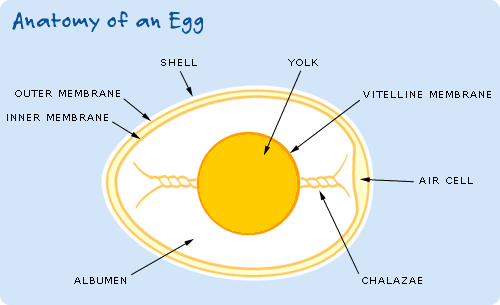
Have you ever wondered why an egg has a pointy and a blunt end? When the egg develops, it travels through the hen’s oviduct and spins as calcium forms around the yolk/albumen and membrane. This movement creates a streamlined pointed end in the front, and a blunt end with an air cell at the back (sort of like a bullet going through the barrel of a gun). Once the egg is fully coated in it’s calcium shell and reaches the end of it’s journey, it is flipped over so that the blunt end comes out first. But why?
In architecture, the dome is considered one of the strongest designs. It supports the weight of the roof evenly so that no single point on the dome supports the whole load and gives way under stress.
What has this got to do with laying and storing an egg? The ends of an egg are just like a dome – it’s shell is the strongest on the ends where the greatest arches are! The pointy end is stronger by design, but the blunt end is wider and better able distribute pressure more evenly all over the shell and it has a cushioning air cell beneath the surface. This makes for a better landing, more surface area for cushioning and less likelihood of the egg being broken as it exits the hen’s body.
Great! So should you store your eggs on the blunt end with it’s greater width and weight distribution? No! And here’s why … remember that air cell I mentioned?
The air cell is located at the blunt end of the egg. Air, of course, is lighter than the other contents of an egg. Therefore, if you store an egg with the blunt-side down, the air sac will be at the bottom, where it will push up against the egg whites and the yolk as it tries to rise to the top. As an egg gets older, the strands of proteins that tether the yolk to the egg whites begin to break down, making it easier for air to push the yolk around. Over time, the air cell ruptures transferring bacteria to the yolk where conditions for growth are optimum and your egg will spoil.
Eggs should always be stored with the pointed end down.
If you keep eggs pointy-end down, however, you limit the effects of gravity, because the air sac is already on top. The white or albumen is alkaline and not as conducive to bacterial growth and it keeps the yolk centered nicely within itself even when the air cell size increases. You reduce the risk of the egg spoiling, the strong pointy end protects the egg from breakage at the bottom, and your egg stays fresh for longer!
Why does it really matter? If you sell table eggs and don’t have to store them for any length of time it may not be as necessary to concern yourself with it; however, no one wants their eggs to be the source of someone getting sick and since you don’t know how or for how long they will be stored on the buyer’s end, it is usually best to ensure they are blunt side up when you sell them so the buyer doesn’t have to worry about it. If you wash your eggs this also takes on a more important role, since washing removes the protective bloom on the outside of the egg that helps to limit bacteria from penetrating the shell, there is a greater chance that bacteria will have entered the air cell. Washed eggs should always be stored in the refrigerator to slow bacterial growth.
If you are selling hatching eggs, this takes on a different issue – saddling and bacteria will considerably reduce viability of that egg to produce a chick that makes it through incubation to hatch. Eggs for hatching should be stored in a cool location, blunt end up, and some say to tilt them slightly from side to side several times daily. Eggs for hatching should be incubated as fresh as possible, with storage time less than 2 weeks for optimal viability.
 Ravenwood Acres
We are told to always store eggs or put them in an incubator with the pointed egg down. But under a sitting bird or hen the eggs naturally gravitate so they are laying on their side.
Doesn’t nature know best and shouldn’t we imitate it?
Good question Mike! My post was specific to storage for eating or for hatching, but yes, under a hen the eggs generally lay on their sides. The dynamic nature of embryo growth and momma hen turning the eggs and changing it’s position often is an entirely different process. Incubators mimic that action by tipping from side to side, and some newer incubators do actually have rollers that enable the egg to lay prone and be turned fully in a 24 hour period. The act of turning the eggs whether upright or prone prevents the chick inside from sticking to the interior of the shell which would prevent proper hatching and ultimately death without assistance. The developing chick, when turned side to side or gradually a full 360 degree rotation is anchored in and fills the entire lower portion of the egg and keeps the membranes of the egg from separating unless it sits for too long allowing the air cell to migrate to the uppermost area. The advantage for placing them upright is that the air cell stays at the top and is easier to monitor and keeps the air cell in the correct position for the chick grow without sticking to the sides and allowing it to eventually pip internally and externally at hatch. Regular turning by the hen also keeps that air cell in the blunt end for the same reason. The active growing embryo inside the egg during setting also has an effect on where that air cell is. Eggs that have been transported but are still clean and intact may have ‘saddled’ air cells which can contribute to early embryo death resulting in blood rings, or later on in development ‘quitters’ as the separated membrane and shell have allowed bacteria in or simple equate to too much movement during rotation. If the embryo does make it to hatch the air cell may be in the incorrect location for pipping or the embryo itself may be upside down in the egg. There are so many factors that can impact hatch, but the air cell location is one that we can control better in an upright position than if it is laying on it’s side. Keep in mind also, that many eggs under a hen won’t hatch for a variety of reasons including that the hen didn’t turn them as often. So, to that end, keeping the egg in a blunt end (air cell up) position allows us better control of the air cell during storage where there are not so many dynamic processes happening.